Well, you're very kind, Fran, but let's not overstate my tinkering around on a guitar. I'm blown away by
real guitarists, and frequently reminded of my own limitations.
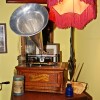
But that brings me back to the charms of each era of sound reproduction. The 1890s are awash in brown wax, with its peculiar aroma and the distinctive looking talking machines that played them. Light oak, nickel plate, and black enamel were the typical visual cues. Berliner Gramophones ground away (and I do mean grind!) on their 7-inch discs which offered volume that impressed listeners at the time, but whose attractions are mostly lost on 21th century ears. Still, these records and machines represent a heartbeat in time in the development of sound recording, and presaged a revolution in format.
The early 1900s brought more refined cylinder machines and breathtakingly improved recordings. Victors and Columbias became rear-mounted, which was gentler to records, and improved disc recording lent a sound that was distinctive. Modern collectors can tell the difference between a cylinder or disc record from the next room. Cabinets became generally darker and more rounded. Horns literally flowered from their drab beginnings into colorful celebrations of sound.
By the end of the century's first decade, cylinder machines had evolved to a new level. Mechanical amplification, 4 minute records (in celluloid even!), rear-mounted horns like their disc brethren, more sophisticated cabinetry, and even internal horns to mimic Victor's marketing phenomenon - the Victrola. Horns began to revert back to basic black, while offering improved performance (as in the Edison Cygnet) in their twilight years (at least in the U.S.).
The Edison Disc Phonograph introduced a commercially viable way to reproduce vertically recorded discs without violating existing patents. In so doing, it also produced arguably the best acoustic reproduction of the pre-1925 period. Again, a distinctive sound and a distinctive look. After more than a decade of disc playing machines, the Edison looked and sounded like nothing else. An overbuilt, beautifully designed system (thanks to John Constable) that was mismanaged (thanks to Thomas Edison), yet sold surprisingly well. There's nothing else like them.
Orthonophonics, Viva-Tonals, and Panatropes in the twenties...each with a different sound, look, and "feel" to them.
The advertising for each era was as distinctive as the products. And again, experienced collectors can usually bracket an undated advertisement to within a couple of years of its actual age because of this constant evolution of tastes and styles.
How can anyone not love this hobby?

George P.
![[The Talking Machine Forum - For All Antique Phonographs & Recordings]](/styles/we_universal/theme/images/the_talking_machine_forum.png)