Lucius1958 wrote:
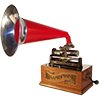
There is one detail that interests me, though. On the original horn, the crimped end seems to be fairly long, compared to an example I have. Were there variations between the early and late B&B horns?
Bill
I believe different manufacturers constructed these 14" b&b horns differently. For example, the Tea Tray Company is known to have constructed larger horns with brass tubes soldered into the small ends. Then, the company applied for a patent (granted Aug. 22, 1905) which involved crimping and shaping the small end. This technique was applied to the company's 14" b&b horns as well.
At about the same time, The Standard Metal Manufacturing Company began making horns with shaped ends, but the crimping was a bit different and not as strong as that of Tea Tray. However, Standard's earliest horns had also employed tubes in the small ends. I do not know for certain if Standard was supplying 14" b&b horns, but it's quite possible.
Hawthorne & Sheble also used straight tubes in the small ends of its early horns. H&S, like Tea Tray, applied for, and was eventually awarded, a patent for a method of shaping and crimping the small end of a horn. These ends are most often seen in the small aluminum horns supplied with some Graphophones. The relationship between Edison and H&S was strained after an 1899 lawsuit, so you won't find H&S horns supplied with Edison Phonographs as factory equipment after that point.
It's really too bad that the 14" b&b horns were not marked somehow so that their origins can be definitively known. The Aug. 22, 1905 date sometimes found stamped into a horn is the well-known Tea Tray patent, but it's not known if H&S and/or Standard manufactured similarly built/marked horns under license from Tea Tray.
At this point, I believe that most of the 14" b&b horns were manufactured by Tea Tray (with earlier production differing from later production). The vast majority of these horns were supplied with Edison machines (Offhand, I can't think of a cylinder Graphophone that came from the factory with a 14" b&b horn). There's also a possibility that Standard Metal Manufacturing supplied 14" b&b horns to Edison. The specifications for these horns would have been the same, so determining the manufacturer - especially over 110 years later, is quite difficult.
George P.
![[The Talking Machine Forum - For All Antique Phonographs & Recordings]](/styles/we_universal/theme/images/the_talking_machine_forum.png)

 )
)