![[The Talking Machine Forum - For All Antique Phonographs & Recordings]](/styles/we_universal/theme/images/the_talking_machine_forum.png)

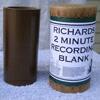

for a reasonable price, those are very good to use
when starting out learning to record on cylinders.
Those are what I cut my teeth on from 1978, until
2009. The long time gap there was due to my never
having finished some details on my cylinder mold.
Finally finished it up in summer, 2009.
That was good too, because by then I'd pretty much ran
out of available Ediphone dictation cylinders, and so
I needed to learn to make my own brown wax and be able
to cast my own blanks from scratch.
Plus the fact that by then I had also realized that it's
kind of a shame to ruin a perfectly good NOS Ediphone
cylinder by cutting it down to cylinder phonograph size.
Just to give you an idea what all that is about:
Brand new never used Ediphone cylinders are usually
about 2.384 inch diameter, and they are 6 inches long.
As such, they can provide at least 100 shave and record
cycles when used on a dictation machine.
However, in order to turn one of those into a useful
Edison cylinder phonograph blank, it must be shaved
down from 2.384 to 2.196. That's a difference of
.188 on the diameter, so it's .094 on the radius.
Dividing .094 by .003125 (the .003125 as you may recall,
is the distance the cutter moves when the adjuster
wheel is turned 45 degrees, and it's about the most
wax to ever take off in one pass), anyway that division
results in an answer of about 30 shaves to get from
2.384 down to the highest phonograph blank diameter
of 2.196.
So, right off the getgo, one must waste all of that
dictation recording time! Then also, the blank must
be shortened from 6 inches to 4.5 inches or so.
However wasteful this procedure might be, it does
definitely produce a very useful blank for recording
experiments on an Edison phonograph.
Your other options would be Shawn's brown wax blanks,
Paul Morris's blanks, or my blanks. Or....you can
even go on flea-bay and find shaved original brown wax blanks for not too much money.
The numbers you'll be dealing with work approximately
this way: A full-diameter Edison phonograph blank
is about 2.196 inch diameter. It can be shaved and
recorded upon about 19 times, (being shaved down
.002 inch on the radius each time), before finally
ending up at 2.112 inch diameter, which is about the
lowest it can go before bottoming out in the limit
loop of the reproducer and the recorder.
So, when ever you might purchase a shaved-down brown wax
blank on flea-bay, the first thing to do when it
arrives is to measure its diameter using a calipers
to see where it is in that range from 2.196 to 2.112
That way, you can get some idea how much meat is on
there and how many shaves it has left in it.
(like of it's 2.120 or some low number, then maybe save
it for a special recording because it's close to the
bottom)....(where as if it's more like 2.180 or so,
you are good to go for many experiments!
 )
)If you do get some Ediphone or Dictaphone blanks,
those can easily be cut to length using the shaver.
Cut a couple of thin pieces of cardboard to cover
the shaver mandrel to protect it from scratches.
Then mark the location of the cut, which should be
about 1.5 inches from the title end. Place the cardboard pieces on the mandrel and push the blank
on there. Close the gate and spin it up, then take
a large darning needle and gently start the cut.
Swing the the darning needle back and forth through
about a 45 degree arc so it makes
a fairly wide cut, this provides room for the wax
chunks to get out. Soon you'll get down to the
cloth webbing at the bottom, then you'll be at the
cardboard. Be careful when it gets down there because
it can rather quickly cut through the cardboard then you'll have the tellale ring scratched on to your shaver
mandrel. (ask me how I know this....
 )
)Anyway, it is up to you whether or not you choose to
cut it off first, then shave it down, or shave it down
first then cut it off. I usually cut it off
first, then shaved it. But it can go either way.
I hope this helps some.