Page 1 of 1
Trying to identify this machine I found
Posted: Wed Oct 09, 2024 4:26 am
by andl2ew
I found this in an alley and I was wondering what model this is, it's a Sorona and it says Macdonald and Preston next to the stylus.
Re: Trying to identify this machine I found
Posted: Wed Oct 09, 2024 2:55 pm
by OrthoFan
It looks like the Sonora "Prelude" from 1926. Here's a capture from Joe Wakeman's book about Sonora Phonographs:
ALSO see --
https://www.collectorsweekly.com/storie ... gramophone
Based on this YouTube video, it has a pretty nice sound quality --
https://www.youtube.com/watch?v=YFelbVzzjis
Re: Trying to identify this machine I found
Posted: Wed Oct 09, 2024 9:34 pm
by andl2ew
Mine looks identical to that first one except mine has a crank like the 2nd one to the right of it and it doesn't have those foot holder things on the bottom of it (I know that's not what they are but don't know what they are called.)

Re: Trying to identify this machine I found
Posted: Thu Oct 10, 2024 5:18 pm
by VanEpsFan1914
The "foot holder things" might be "stretchers." A very common thing on 1920s furniture in general to keep it from getting wobbly.
As mains electricity was getting more common in the '20s people would sometimes buy electric phonographs, so the Prelude shown in the Joe Wakeman book is probably electric. These used the electricity only to power the turntable, using a standard acoustic style tonearm like your hand-cranked example.
Beautiful phonograph. It's a good decorator's piece and even more fun if it still works. The motors generally could stand servicing after a century or more of use and idleness, and the reproducer (on the tonearm, the part which holds the needle) really will need a servicing after all these years.
Good news! These things are made to be repaired, and parts for these are super cheap (you really start paying big bucks either with the rare early models, or with the electronic machines.) If you still have mainsprings that work and a reasonably healthy reproducer it will probably come back to life easily.
To play a record:
Put on a 78rpm record,
Wind the motor up with the crank,
Release the brakes with the lever by the platter's edge
With a new steel needle in the soundbox, lower it into the edge of the record just like a modern LP,
- and the phonograph will take care of the rest, so sit back and enjoy your music.
Are you new to 78s? Pretty much anything and everything got onto shellac 78s in the early years of the music industry.
Re: Trying to identify this machine I found
Posted: Fri Oct 11, 2024 10:28 pm
by andl2ew
I'm gonna use your advice here and see if it works, it still has the needle and everything so it should. But my main goal here was to see if it's worth anything when it's refurbished.
Re: Trying to identify this machine I found
Posted: Sat Oct 12, 2024 4:24 am
by epigramophone
andl2ew wrote: Fri Oct 11, 2024 10:28 pm
I'm gonna use your advice here and see if it works, it still has the needle and everything so it should. But my main goal here was to see if it's worth anything when it's refurbished.
If you found it in an alley

I assume that it has cost you nothing. It is well worth the effort of restoration, and unless you encounter major expenditure such as new springs, anything you sell it for should show a profit. If it was mine I would keep it.
If as you say it still has the needle, it may be worn and could damage any record played. I would discard it and buy new.
Re: Trying to identify this machine I found
Posted: Sat Oct 12, 2024 8:23 am
by VanEpsFan1914
Needles only get used one time in these older windup machines.
Edison made multiple use needles because the wax cylinder records aren't abrasive so they got played with sapphire styli. Likewise the Edison Diamond Disc, sold 1912 to 1989, used a diamond stylus and a weirdly complicated mechanical feed system to swing the needle across the record. It's a fun system. Here's mine.
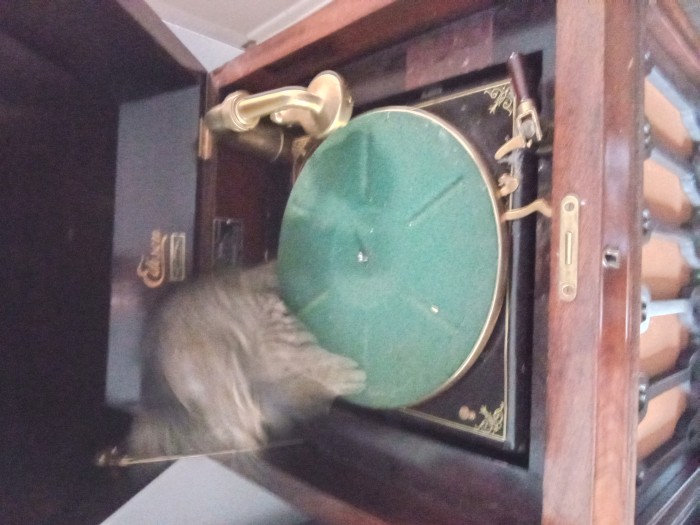
- Edison
Usually they don't come with kittens. I'm glad she grew out of the climbing phase.
You have a 78rpm machine for lateral cut records. This means the shellac composition discs are going to be somewhat gritty. That's fine. But it also means you will be changing your needle each time you play it.
I would suggest releasing the brake lever, and then gently turn the crank several times until the platter starts to rotate. Let go of the crank and see if it keeps spinning. If it does stay running you probably are OK to start your restoration on Easy Mode.
Needles. The old cans are cool looking but I personally just buy bags of new ones from The Phonograph Shop, Cabarrus Station, North Carolina. Here's the needle buffet (not sure the technical term) in my 1914 Victrola XIV. You put different loudnesses of needles in different cups, and when you are done you simply drop the used needle through the silver hole in the other side.
On your Sonora Prelude, you have bowls right there on the top deck. Nice.
Ok and that name, on the tag next to the brake lever, that's the music store that sold it originally. It's called a dealer tag and they're a good way to tell the provenance of a piece. Now I did find one in my 1912 Edison Disc machine but most of mine don't have anything fun like that so you can probably look up where your Sonora came from by that tag.
Now I don't have a Sonora, so I can't share pictures, but I do have a mid-1920s Northome that I've knocked apart for repairing at the moment and stripped down to refinish. The difference between yours and mine is that yours already looks good and is complete. Have fun.
Re: Trying to identify this machine I found
Posted: Sun Oct 13, 2024 12:52 am
by andl2ew
Thank you guys for all the information.
Re: Trying to identify this machine I found
Posted: Sun Oct 13, 2024 2:46 am
by Inigo
What a lucky finding... I hope you enjoy it. It looks fantastic and in good shape...