![[The Talking Machine Forum - For All Antique Phonographs & Recordings]](/styles/we_universal/theme/images/the_talking_machine_forum.png)

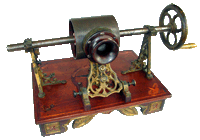
Can anyone ID this phonograph? The works flips over to store inside the lower part of the cabinet.
Thanks, Greg
What is this phonograph?
-
phono-farm
- Victor O
- Posts: 73
- Joined: Wed Jan 07, 2009 11:58 pm
- Contact:
What is this phonograph?
- Attachments
-
-
TinfoilPhono
- Victor V
- Posts: 2059
- Joined: Thu Jan 08, 2009 8:48 pm
- Location: SF Bay Area, Calif.
Re: What is this phonograph?
It's a "Crown", missing the gear cover. See the September issue of The Antique Phonograph for the full story about this unusual machine. For the summary, check out my website HERE.
-
phono-farm
- Victor O
- Posts: 73
- Joined: Wed Jan 07, 2009 11:58 pm
- Contact:
Re: What is this phonograph?
THANK YOU! I might never have figured this out. It looks like the metal base on mine is different, which I assume is either earlier or later than yours. I'd be interested in getting the reproducer, gear cover, and horn if anyone has those.TinfoilPhono wrote:It's a "Crown"
Greg Farmer
-
TinfoilPhono
- Victor V
- Posts: 2059
- Joined: Thu Jan 08, 2009 8:48 pm
- Location: SF Bay Area, Calif.
Re: What is this phonograph?
For a machine which was only in the market for a very short time (1908 to early 1909) it's surprising how much variation there is among them. There were at least two different reproducers used, and two or three different horns (though only the miniature morning glory was shown in ads). I'm not surprised that there would be some variations in the shape of the base.
You could use a Puck reproducer. It's very similar to the other known original style. I know one collector who is using a Columbia Eagle reproducer, definitely not correct but it functions.
The alternate horns that have been found with Crown phonographs are very short brass belled types, as can be seen in the Fabrizio/Paul "Compendium". I much prefer the mini-MG myself but those aren't very easy to find.
You could use a Puck reproducer. It's very similar to the other known original style. I know one collector who is using a Columbia Eagle reproducer, definitely not correct but it functions.
The alternate horns that have been found with Crown phonographs are very short brass belled types, as can be seen in the Fabrizio/Paul "Compendium". I much prefer the mini-MG myself but those aren't very easy to find.
-
phono-farm
- Victor O
- Posts: 73
- Joined: Wed Jan 07, 2009 11:58 pm
- Contact:
Re: What is this phonograph?
Hi Again,
I've been studying your online Crown article and photos. I see that mine has a toned-down version (not very spectacular) of the oxidized finish on the sides of both motor plates, but nowhere else. I don't know the history of my machine, but I'm wondering if possibly your oxidized base might actually be a separate cover of decorative metal fitting over a more solid piece of metal like what I see on mine, i.e. maybe mine is missing an oxidized cover? Comparing screw hole positions relative to the edges and the end motor plate looks like this could be the case.
Also, I'm attaching 2 photos of my motor. It's a poorly engineered thing that runs noisily with lots of slop in all the moving parts. The spring has a large washer on one side and a nail used like a cotter pin to keep the washer somewhat against the spring, but it looks wrong, especially the nail. And the large gear on the other side of the spring sometimes looks straight but sometimes looks crooked on the shaft. I need to take this apart to see it better, but something's not right. Also, the speed control/on-off control is really rinky-dink. Do you know if this is how yours looks inside? Maybe the metal cover is difficult to remove - another design flaw I see is that the spring expands out beyond the motor framework and would push hard against the metal cover. It'd be interesting to see a side view of the cover to see how it is bent and how it is held on - maybe I could make one.
Finally, should this have the Crown name, or any other ID on it anywhere? I don't see any indication of an old decal, label, numbers, letters, marks, or anything else that gives any clue to what it is. I really am grateful that you have identified it for me and your article is more than I could have expected.
Many thanks,
Greg Farmer
I've been studying your online Crown article and photos. I see that mine has a toned-down version (not very spectacular) of the oxidized finish on the sides of both motor plates, but nowhere else. I don't know the history of my machine, but I'm wondering if possibly your oxidized base might actually be a separate cover of decorative metal fitting over a more solid piece of metal like what I see on mine, i.e. maybe mine is missing an oxidized cover? Comparing screw hole positions relative to the edges and the end motor plate looks like this could be the case.
Also, I'm attaching 2 photos of my motor. It's a poorly engineered thing that runs noisily with lots of slop in all the moving parts. The spring has a large washer on one side and a nail used like a cotter pin to keep the washer somewhat against the spring, but it looks wrong, especially the nail. And the large gear on the other side of the spring sometimes looks straight but sometimes looks crooked on the shaft. I need to take this apart to see it better, but something's not right. Also, the speed control/on-off control is really rinky-dink. Do you know if this is how yours looks inside? Maybe the metal cover is difficult to remove - another design flaw I see is that the spring expands out beyond the motor framework and would push hard against the metal cover. It'd be interesting to see a side view of the cover to see how it is bent and how it is held on - maybe I could make one.
Finally, should this have the Crown name, or any other ID on it anywhere? I don't see any indication of an old decal, label, numbers, letters, marks, or anything else that gives any clue to what it is. I really am grateful that you have identified it for me and your article is more than I could have expected.
Many thanks,
Greg Farmer
- Attachments
-
-
-
TinfoilPhono
- Victor V
- Posts: 2059
- Joined: Thu Jan 08, 2009 8:48 pm
- Location: SF Bay Area, Calif.
Re: What is this phonograph?
There's no flat base under the existing base with curved edges -- it's a single piece of relatively thin stamped steel.
The cover is a simple sheet of metal with bends for front and back, and tabs which fit into slots in the base. The front has two tabs bent outward to lock in place, the back has one single tab that relies solely on pressure to secure it. Looking at your photos I don't see similar holes for mounting a cover. Maybe they cheapened it at some point in production?
There are no markings or decals of any kind. I was only able to identify it from the picture in the Fabrizio/Paul "Compendium", and later the original ads in Talking Machine World, which George turned me on to.
The spring very definitely presses against the cover, and hard. You can see how the cover is bowed at the front. It's a pretty silly design.
I have no clue what the washer next to the spring on yours is all about. There's a metal tab on mine, to the right of the spring, bent up from the base. I'm not sure what that is supposed to do but it's in approximately the same area as your washer. Your main winding gear appears to be bent so it won't engage the pinion properly.
Hopefully these pictures will help. There's an obvious difference in the governor balls between the two machines.
EDIT TO ADD: On further reflection the upright tab next to my mainspring is most likely to prevent the center of the spring from bulging outward and uncoiling as it winds or unwinds. Since your base is different the washer is likely meant to serve the same purpose.
The cover is a simple sheet of metal with bends for front and back, and tabs which fit into slots in the base. The front has two tabs bent outward to lock in place, the back has one single tab that relies solely on pressure to secure it. Looking at your photos I don't see similar holes for mounting a cover. Maybe they cheapened it at some point in production?
There are no markings or decals of any kind. I was only able to identify it from the picture in the Fabrizio/Paul "Compendium", and later the original ads in Talking Machine World, which George turned me on to.
The spring very definitely presses against the cover, and hard. You can see how the cover is bowed at the front. It's a pretty silly design.
I have no clue what the washer next to the spring on yours is all about. There's a metal tab on mine, to the right of the spring, bent up from the base. I'm not sure what that is supposed to do but it's in approximately the same area as your washer. Your main winding gear appears to be bent so it won't engage the pinion properly.
Hopefully these pictures will help. There's an obvious difference in the governor balls between the two machines.
EDIT TO ADD: On further reflection the upright tab next to my mainspring is most likely to prevent the center of the spring from bulging outward and uncoiling as it winds or unwinds. Since your base is different the washer is likely meant to serve the same purpose.
- Attachments
-
-
-
-
-
TinfoilPhono
- Victor V
- Posts: 2059
- Joined: Thu Jan 08, 2009 8:48 pm
- Location: SF Bay Area, Calif.
Re: What is this phonograph?
Another interesting difference I can see in comparing the two machines: the way the spring is mounted. The end of your spring is wrapped around a rod at the lower front of the motor. Mine has no such rod. Instead the spring is attached to holes in the base, as you can see in the picture of the underside of the base.
Fascinating differences for such a short-lived machine!
Fascinating differences for such a short-lived machine!
-
phono-farm
- Victor O
- Posts: 73
- Joined: Wed Jan 07, 2009 11:58 pm
- Contact:
Re: What is this phonograph?
Your photos of the underside and the motor are very interesting! One other major difference is the speed control. Yours looks like it would work fairly well, while mine is the worst design I've seen in any phonograph and is mostly useless. I think the best way to adjust mine would be to bend the metal pieces until the speed is acceptable. Another difference is that your spring is wider than mine. Looking at how your motor cover mounts, I'm thinking that mine might never have had a cover.
So, mine might be a later cheapened version without a motor cover, as you suggested. Or, mine might be an earlier version since yours is better (improved) in several ways. The nail in mine also indicates mine might be a poorly repaired example, and it's impossible to know what else might have been changed.
Greg
So, mine might be a later cheapened version without a motor cover, as you suggested. Or, mine might be an earlier version since yours is better (improved) in several ways. The nail in mine also indicates mine might be a poorly repaired example, and it's impossible to know what else might have been changed.
Greg