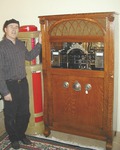
New to forum with Brunswick Panatrope 42DC

Discussions on Talking Machines & Accessories
Uncle Vanya
Victor IV
Posts: 1269
Joined: Sun Oct 25, 2009 12:53 pm
Location: Michiana

Re: New to forum with Brunswick Panatrope 42DC

Post by Uncle Vanya »

rebrands wrote:I'e been busy entertaining three granddaughters, ages 7, 5, and 2 today. For some reason they take priority over radios, so I'm doing this after their bedtime. Their parents get them back Sat. Exhausting and exhilarating.
I fixed a audio transformer one time by zapping it.
I did this by charging up a large electrolytic capacitor to 90 volts and the connecting the leads to the open winding of the transformer, the resulting arc welded the open coil and then it showed continuity.
I never thought of zapping a transformer to revive it. I've nothing to lose. I'll let you know the outcome. I'm not too hopeful as it looks to have been overheated previously - bubbly tar.
Positive goes to +C at the midpoint of the last two 71 filaments on the right in the schematic
I've not yet located any connection corresponding to the C+ label on the schematic.
What type of plug/connector is coming out of the chassis? Three pin? Some of the old radio batteries had the mating plug on them
The wire pair/connector is in the attached photo, but a battery connection may be a possibility.
For the interstage transformer use a standard 3:1 center tapped unit from Hammomd or Stancor. The center tap goes to the negative terminal bias battery (C-) the positive terminal goes to the C+ terminal. The schematic indicates this, you also have a -3v bias that needs to be connected for the first audio tube.
Most interstage transformers list their ratio as 1:2 or 1:3, rather than 2:1, 3:1. I assume that is the primary to secondary ratio. If so I would need to reverse a 1:2 to arrive at a 2:1 winding ratio. Maybe two transformers in series or parallel to arrive at the winding arrangement I need?

I am mystified why the two pairs of output tubes would be biased differently. They look balanced to me, but maybe the way the filaments are powered as mentioned?
doesn't show the voltage dividers and circuits used to produce the lower voltages and negative grid bias voltages. "IF" this is for use on Household DC voltage, then there has to be another chassis with the resistors and inductors needed to provide the various voltages to the points on the schematic as shown.
The three volt bias is adjusted with an external pot.

I've attached a couple scans of a schematic I have drawn up. It isn't complete, still have more wire tracing to do in the area of V4 and V5. I think the filament circuit diagram should shed some light on the voltage dropping required. The 65 ohm center tapped resistor in parallel with the field coil is a monster, mounted on the bottom of the cabinet with a patch of ASBESTOS insulating it from the cabinet, and a wire mesh to keep from touching it. Yeah, I hate the style of the original schematic and don't grasp the "dual grids" around the plates.
That connector is from the 1940's. Someone added that connector so that a commonly available portable radio B battery could be used for the C bias on this set.

As for the 3:1 transformer ratio, back in the 1920's a transformer with a 20,000 turn primary and a 60,000 turn secondary would have been called 3:1. Sort of like capacitors being called "condensers". Sorry if my use of these obsolete terms is confusing.

The Stancor transformer that I mentioned in my earlier post will do the trick, though.

It looks like the C+ connection on your set should go to earth (chassis ground).
User avatar
howardpgh
Victor II
Posts: 434
Joined: Sun Mar 10, 2013 4:34 pm
Location: Pittsburgh

Re: New to forum with Brunswick Panatrope 42DC

Post by howardpgh »

I believe the "C" bias voltages were provide by separate dry batteries.
Where do the indirectly heated cathodes of the 24s and 27 get connected to?

rebrands
Victor Jr
Posts: 16
Joined: Sat Mar 26, 2016 3:37 pm

Re: New to forum with Brunswick Panatrope 42DC

Post by rebrands »

The turns ratio information is just what I was looking for. I wondered if there was a change in convention somewhere back there, but didn't have the background knowledge you provided. Thanks. I'll check out the transformer you referenced earlier.

As for the indirectly heated cathodes, pin 4 on the 24s, they are connected together in a string. It may be hard to pick out in the schematic as the line runs close to the edge circle that indicates the tube itself. The cathode on the 27, I have not completely traced out yet, there are several gaps in this drawing as it currently sits, and possibly an error in that the plate of V4 shows a connection to the cathode string - it looks wrong to me.

One thing that looks odd to me is that one end of the 65 ohm ballast resistor is "floating" with the field coil and just the center tap being connected. But I've checked it numerous times and that is the way it is.

rebrands
Victor Jr
Posts: 16
Joined: Sat Mar 26, 2016 3:37 pm

Re: New to forum with Brunswick Panatrope 42DC

Post by rebrands »

I fixed a audio transformer one time by zapping it.
I did this by charging up a large electrolytic capacitor to 90 volts and the connecting the leads to the open winding of the transformer, the resulting arc welded the open coil and then it showed continuity.
I tried the zap routine with no luck, not enough volts to bridge the gap. I charged up to 100v. I guess I'll be buying the Stancor 4774.

User avatar
Governor Flyball
Victor II
Posts: 313
Joined: Thu Nov 26, 2015 8:59 pm
Location: Waterloo, Ontario, Canada

Re: New to forum with Brunswick Panatrope 42DC

Post by Governor Flyball »

The re-drawing depicts the filaments incorrectly. The 32's draw less filament current hence they are in parallel and the '71's are in series.

Do you have a 120VDC supply to run this? Otherwise I would modify the design to accommodate a modern dedicated regulated supply of the AC mains so that the filaments for the '71's and 32's are paralleled and provided with separated DC supplies. The plate and bias supplies can also be made independent. This would eliminate the need for the split transformer secondary and eliminate the series ballast resistance protecting the precious tube filaments.

Is the turntable DC powered or is it simply spring driven?

rebrands wrote:I'e been busy entertaining three granddaughters, ages 7, 5, and 2 today. For some reason they take priority over radios, so I'm doing this after their bedtime. Their parents get them back Sat. Exhausting and exhilarating.
I fixed a audio transformer one time by zapping it.
I did this by charging up a large electrolytic capacitor to 90 volts and the connecting the leads to the open winding of the transformer, the resulting arc welded the open coil and then it showed continuity.
I never thought of zapping a transformer to revive it. I've nothing to lose. I'll let you know the outcome. I'm not too hopeful as it looks to have been overheated previously - bubbly tar.
Positive goes to +C at the midpoint of the last two 71 filaments on the right in the schematic
I've not yet located any connection corresponding to the C+ label on the schematic.
What type of plug/connector is coming out of the chassis? Three pin? Some of the old radio batteries had the mating plug on them
The wire pair/connector is in the attached photo, but a battery connection may be a possibility.
For the interstage transformer use a standard 3:1 center tapped unit from Hammomd or Stancor. The center tap goes to the negative terminal bias battery (C-) the positive terminal goes to the C+ terminal. The schematic indicates this, you also have a -3v bias that needs to be connected for the first audio tube.
Most interstage transformers list their ratio as 1:2 or 1:3, rather than 2:1, 3:1. I assume that is the primary to secondary ratio. If so I would need to reverse a 1:2 to arrive at a 2:1 winding ratio. Maybe two transformers in series or parallel to arrive at the winding arrangement I need?

I am mystified why the two pairs of output tubes would be biased differently. They look balanced to me, but maybe the way the filaments are powered as mentioned?
doesn't show the voltage dividers and circuits used to produce the lower voltages and negative grid bias voltages. "IF" this is for use on Household DC voltage, then there has to be another chassis with the resistors and inductors needed to provide the various voltages to the points on the schematic as shown.
The three volt bias is adjusted with an external pot.

I've attached a couple scans of a schematic I have drawn up. It isn't complete, still have more wire tracing to do in the area of V4 and V5. I think the filament circuit diagram should shed some light on the voltage dropping required. The 65 ohm center tapped resistor in parallel with the field coil is a monster, mounted on the bottom of the cabinet with a patch of ASBESTOS insulating it from the cabinet, and a wire mesh to keep from touching it. Yeah, I hate the style of the original schematic and don't grasp the "dual grids" around the plates.

User avatar
Governor Flyball
Victor II
Posts: 313
Joined: Thu Nov 26, 2015 8:59 pm
Location: Waterloo, Ontario, Canada

Re: New to forum with Brunswick Panatrope 42DC

Post by Governor Flyball »

I am seeing further errors in the re-drawing. AC tubes have been substituted. Each pass 1.75A filament current and the 71A's in parallel as drawn require 2.0A. If implemented as depicted, the ballast will dissipate close to 200 watts. The use of the 24a and 27 were not intended for transformer-less operation.

I trust the 32's a 30 and the'71a's were in the original design?

Uncle Vanya
Victor IV
Posts: 1269
Joined: Sun Oct 25, 2009 12:53 pm
Location: Michiana

Re: New to forum with Brunswick Panatrope 42DC

Post by Uncle Vanya »

2.5 volt indirectly heated tubes were used in this manner in some 110 volt DC sets in 1930 and 1931, until the development of the automobile series of tubes with their 6.3 volt heaters and oddball tubes like the 14. This set is not particularly unusual in this regard. The complement of "air cell" tubes shown in the factory schematic may well have been problematic; noisy and cranky, oarticulalry if used in a power supply with a good deal of commutator ripple, like a city central station system.

rebrands
Victor Jr
Posts: 16
Joined: Sat Mar 26, 2016 3:37 pm

Re: New to forum with Brunswick Panatrope 42DC

Post by rebrands »

Sorry for the long silence, I've been out of town, just got back last night (to a foot of snow!).
The re-drawing depicts the filaments incorrectly. The 32's draw less filament current hence they are in parallel and the '71's are in series.

Do you have a 120VDC supply to run this? Otherwise I would modify the design to accommodate a modern dedicated regulated supply of the AC mains so that the filaments for the '71's and 32's are paralleled and provided with separated DC supplies. The plate and bias supplies can also be made independent. This would eliminate the need for the split transformer secondary and eliminate the series ballast resistance protecting the precious tube filaments.

Is the turntable DC powered or is it simply spring driven?
I can assure you that the correct tubes are 24s, not 32s. The sockets are labeled as such. I have triple checked the filament wiring and am confident that the re-draw is correct in that respect. Not that much confidence in the rest of the circuit yet though.

My plan is to use a bridge rectifier and filter caps to provide the required DC power.

The turntable is an electric motor with brushes, so it may be AC/DC, I've not checked that yet.
he ballast will dissipate close to 200 watts
The ballast resistor, located on the bottom of the cabinet, is a monster and may well be capable of 200 watts. See photo attached earlier.

Meanwhile, I have ordered and received a Stancor A4774 interstage transformer that has split secondaries. I'm thinking of doing this mod to remove the DC load on the transformer.
mod1.jpg
mod1.jpg (34.01 KiB) Viewed 1591 times
We'll see how that goes.

I also have to do further checking to locate the reason the original transformer failed.

User avatar
startgroove
Victor III
Posts: 887
Joined: Sat Apr 20, 2013 3:01 pm
Location: Coos Bay, Oregon

Re: New to forum with Brunswick Panatrope 42DC

Post by startgroove »

Great to see you are back! Just thought I'd suggest a caution here. Be careful about providing source DC by using a solid state rectifier. On power up, the potential at the rectifiers could be twice the normal potential until the filaments have warmed enough to cause the proper load on the supply. Some components may not be able to handle the temporary higher voltage.

rebrands
Victor Jr
Posts: 16
Joined: Sat Mar 26, 2016 3:37 pm

Re: New to forum with Brunswick Panatrope 42DC

Post by rebrands »

That's a good thought. I'll keep that in mind. Maybe a NTC thermistor to limit inrush?

Post Reply