rgordon939 wrote:The purpose of the ring that you circled is a stop to keep the shaver from coming out of the carriage. The beveled edge of the sapphire cutter should face down. Here is a picture of my shaver. My shaver has the electric motor option and you can see it in operation at this link. https://m.youtube.com/watch?v=sxxkFY-yJys
Interesting: so your shaver works from right to left?
Also, is the knurled knob at the end of the shaft a fine depth control?
All of the shaving machines I have ever seen or worked
with travel from right to left.
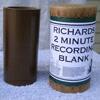
Rich, yes, indeed those original brown wax blanks
shown in your picture are very shiny, which means they
are very nicely shaved!
By the way, what is the noise level on those?
Just play the smooth shaved surface using a model C
reproducer and listen to the surface noise. I am
curious what the noise level is on those old original
blanks.
I always do that test on every blank I make, playing
the entire first smooth surface, checking it, listening
for noise.
The largest diameter blank which works with
my recorders and reproducers is (as Shawn already said)
2.196 inches. Any larger than that, and it runs the risk of jamming the reproducer limit pin up against the
reproducer body.
Years ago I took a few of my experimental blanks to
the Union, Illinois show and went around and played them
on various machines, checking the clearance.
It was found that 2.190 worked nicely on all machines
tested.
In an informal survey of some Edison original brown
wax blanks which are believed to be still at their
original factory (as shipped) diameter, it was found that they all were very close in the range of
2.180 to about 2.182 inch diameter or so.
My standard working diameter range is from 2.196
down to 2.112. Any less than 2.112 is so low that
the recorders and the reproducer bottom out and can't
reach the record any more.
That is a working diameter range of .084 inches.
Then, working from there, it can be said that
an average shaving which completely erases a recording
is .004 inches on the diameter. (Louder recordings
will sometimes have a few pits left, and maybe need
more like .005 taken off, but .004 is average)
So then, from there, it can then be said that if
a blank starts out at 2.196 inch diameter and then
is shaved and recorded upon until it gets down to
2.112 inch diameter, that the process will have
taken 21 shaves of .004 each to get there.
So, 21 recording surfaces is my ideal maximum.
This is not always possible, and so the real actual
amount of shave-and-record cycles is more like
15 or so.
"Sustained success depends on searching
for, and gaining, fundamental understanding"
The cutting head on all my shavers, also move from right to left, as they are high speed, and if they went left to right, the impact of the cutter going on the blank would eject the blank off the mandrel, and smash it.
Bill, I've never worked with a hand cranked type
of a shaver. The only ones I have worked with are
motor driven. And, yeah, Shawn is right about it
being a good idea that the motion of the shaver
carriage tends to force the cylinder on to the mandrel
instead of tending to push it off as it would if
it moved from left to right.
"Sustained success depends on searching
for, and gaining, fundamental understanding"
Bill you might want to check the belt on your machine. It may be installed incorrectly causing the mandrel to travel in the wrong direction. I believe on the hand crank machines the belt forms a figure 8. If yours does try reversing one end of the figure 8. That should change the direction of the mandrel.
This may be a little off topic, but would a freshly honed high speed steel lathe cutting tool not leave a nice finish? I don't have a shaver, but I do have a couple of metal lathes I was hoping to use.
![[The Talking Machine Forum - For All Antique Phonographs & Recordings]](/styles/we_universal/theme/images/the_talking_machine_forum.png)