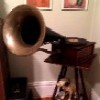
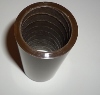
I just purchased a notched recorder for my Edison Standard. The stylus is loose from the glass diaphragm. Could someone please post photos showing how or information pertaining to how this piece should be attached? I'm attaching a couple of photos from the auction (not very clear unfortunately) showing its current condition.
I also have a couple of questions regarding the recording process. Should I be looking for a larger horn? My standard has the small 14" horn. I have seen recordings being made with larger horns, so I assume that is a necessity. Also, who supplies the blank wax cylinders?
Thank you!
Ed
Edison notched recorder/ cylinder recording questions
- Edisonh19
- Victor I
- Posts: 129
- Joined: Fri Mar 06, 2015 8:04 pm
- Location: Pittsburgh
- Lucius1958
- Victor Monarch
- Posts: 4103
- Joined: Tue Dec 14, 2010 12:17 am
- Personal Text: 'Don't take Life so serious, son. It ain't nohow permanent.' - 'POGO'
- Location: Where there's "hamburger ALL OVER the highway"...
Re: Edison notched recorder/ cylinder recording questions
See your previous post for my suggestions.
Bill
Bill
- edisonphonoworks
- Victor IV
- Posts: 1566
- Joined: Wed Oct 21, 2009 10:50 am
- Personal Text: A new blank with authentic formula and spiral core!
- Contact:
Re: Edison notched recorder/ cylinder recording questions
First it looks like it is all there, does it have a clear cylinder shaped stylus with a cupped center at the end of the holder? It is best to clean the diaphragm with acetone, and the stylus holder, gently, don't bend or change anything. Next get some REAL beeswax, and make a very thin ring around the diaphragm,Sometimes it is best to melt some on waxed paper on a cookie sheet, at low heat (warm, under 200) in your oven and cut a strip .020 wide with a razor blade, and put around the circumference, and put the recorder in the oven for a minute, just until it is warm but the wax not runny, just to soften it, and with a clean finger, or with surgical gloves seal the bead down the edge of the recorder , some suggest a soldering iron, but you don't want to melt the wax until it is runny or it will get under the diaphragm and cause it to be insensitive. Clean all moving parts with the acetone, any binding will cause problems with the floating part tracking. The holder is attached with the business end of the holder towards the center of the diaphragm clean off the old glue (I am thinking this is a mica diaphragm,however I had made a post recently about where to get new glass diaphragms, the original mica is .002" thick, while a .007 glass will work nicely for most recordings. Make sure your diaphragm if it is mica, has no separation fractures, and that it still has a ting sound when dropped on the side, otherwise order mica with no hole for model C reproducer, and then use a clean razor blade to get layers off .002" thick, to make a new diaphragm. The best cement to cement the stylus holder to the center is Stratina, however the maker of it is not in the best of health. A medium shellac paste is good where flake shellac is dissolved in enough denatured alcohol not runny but a consistency just a little thinner than honey but not runny. let it dry. Blanks for beginner recordist, it might be best to purchase Paul Morris blanks as they are inexpensive, and easy to obtain, then when you get more practice, you can purchase American Blanks from Chuck Richards or myself, I though do not accept orders, I sell what I make at the Union Show only, or when I have extra on my website, and sometimes on ebay. I have regular subscribers who purchase a majority of my blanks.
http://members.tripod.com/~Edison_1/id24.html
My website.
http://richardslaboratories.com/
Chuck Richards
http://www.paulmorrismusic.co.uk/WaxCylinders.asp
Paul Morris UK
I do not suggest destroying original brown wax cylinders to make blanks from. (Would you deliberately break a Berliner disc?) I equate this to one in the same.
Ediphone blanks are plentiful, and you can cut the end off and shave from 2.3" down to 2.195" to obtain a blank, however a dictation machine shaver is needed. Ediphone blanks contain glycerin, and olaic acid in higher quantities, that regular brown wax. If you use them inside, in low humidity, and keep them at a constant temperature you will be fine, if you put them away a long time they will become foggy on the surface. Dication blanks, the recording surface does roughen up, or get noisy after sitting a few weeks.
Horns, make a series of horns from 24-30" long and one of each with 3" opening and one of each with a 6" at the opening out of poster board, use a copper pipe 2" long, glued or epoxied to the small end of the horn, no bell should be present.
http://members.tripod.com/~Edison_1/id24.html
My website.
http://richardslaboratories.com/
Chuck Richards
http://www.paulmorrismusic.co.uk/WaxCylinders.asp
Paul Morris UK
I do not suggest destroying original brown wax cylinders to make blanks from. (Would you deliberately break a Berliner disc?) I equate this to one in the same.
Ediphone blanks are plentiful, and you can cut the end off and shave from 2.3" down to 2.195" to obtain a blank, however a dictation machine shaver is needed. Ediphone blanks contain glycerin, and olaic acid in higher quantities, that regular brown wax. If you use them inside, in low humidity, and keep them at a constant temperature you will be fine, if you put them away a long time they will become foggy on the surface. Dication blanks, the recording surface does roughen up, or get noisy after sitting a few weeks.
Horns, make a series of horns from 24-30" long and one of each with 3" opening and one of each with a 6" at the opening out of poster board, use a copper pipe 2" long, glued or epoxied to the small end of the horn, no bell should be present.
- Edisonh19
- Victor I
- Posts: 129
- Joined: Fri Mar 06, 2015 8:04 pm
- Location: Pittsburgh
Re: Edison notched recorder/ cylinder recording questions
Wow, thank you so much! I really appreciate all the information. I haven't gotten the recorder in the mail yet, but it should be here by the end of the week. I will send an update once it gets here. I'm anxious to play around with it. Unfortunately, I don't make it to that phonograph show. I should make a point to do so one of these days, but my work schedule makes it difficult. I will be in touch about the composition of the diaphragm. I'm anxious to try the recorder out!
Thank you!
Ed
Thank you!
Ed
- edisonphonoworks
- Victor IV
- Posts: 1566
- Joined: Wed Oct 21, 2009 10:50 am
- Personal Text: A new blank with authentic formula and spiral core!
- Contact:
Re: Edison notched recorder/ new style with glass diaphragm
http://www.antiquephono.org/wp-content/ ... corder.jpg
http://www.antiquephono.org/sound-subst ... j-wakeman/
This links to a page for A.P.S by R.J. Wakeman wonderful showing of the first generation of the new style floating diaphragm recorder, at this time it used various glass diaphragms just like the early standard speaker style recorder. This shows that they did use glass in the early days of the new recorder. When I do get some new cutting stylus, I am going to outfit some of the newer style recorders with glass diaphragms. You will see that these early ones, have a notch for the stylus holder to go under, to hold the lower edge, one rubber gasket on the bottom (so they did NOT yet use paper like later ones with mica diaphragms.) The instructions state that no gasket is used, however that "paraffin wax" was used to seal the unit together. To get the old diaphragm out, scrape the paraffin wax away, from the top of the diaphragm, heat the head of a nail and heat the stylus holder, through the glass until the stratina melts, it may crack the diaphragm but is a good way to remove it. Check the rubber gasket, replace if needed, center the glass diaphragm, and wax the edge of glass in place and place the tab in the hole at the edge of the recorder, and stratina the stylus holder down to the glass.
http://www.antiquephono.org/sound-subst ... j-wakeman/
This links to a page for A.P.S by R.J. Wakeman wonderful showing of the first generation of the new style floating diaphragm recorder, at this time it used various glass diaphragms just like the early standard speaker style recorder. This shows that they did use glass in the early days of the new recorder. When I do get some new cutting stylus, I am going to outfit some of the newer style recorders with glass diaphragms. You will see that these early ones, have a notch for the stylus holder to go under, to hold the lower edge, one rubber gasket on the bottom (so they did NOT yet use paper like later ones with mica diaphragms.) The instructions state that no gasket is used, however that "paraffin wax" was used to seal the unit together. To get the old diaphragm out, scrape the paraffin wax away, from the top of the diaphragm, heat the head of a nail and heat the stylus holder, through the glass until the stratina melts, it may crack the diaphragm but is a good way to remove it. Check the rubber gasket, replace if needed, center the glass diaphragm, and wax the edge of glass in place and place the tab in the hole at the edge of the recorder, and stratina the stylus holder down to the glass.
- Edisonh19
- Victor I
- Posts: 129
- Joined: Fri Mar 06, 2015 8:04 pm
- Location: Pittsburgh
Re: Edison notched recorder/ cylinder recording questions
Thank you! More great information. I received my recorder yesterday. It is intact and complete. I had to remove the mica diaphragm (which is still good) and clean the area underneath. There was dirt and corrosion in there that I assume would hinder its recording abilities. I reseated the diaphragm and sealed with beeswax. The recorder stylus appears to be in good shape, almost as if it was not used many times. Everything is back together now, and the unit appears to be ready to record some cylinders. Now I need some cylinders!