![[The Talking Machine Forum - For All Antique Phonographs & Recordings]](/styles/we_universal/theme/images/the_talking_machine_forum.png)

Would like to Record with my Edison Standard B
-
hearsedriver
- Victor III
- Posts: 571
- Joined: Wed Jan 25, 2017 10:21 pm
- Location: Ft.Worth, Texas
Re: Would like to Record with my Edison Standard B
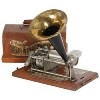
One of our members here was kind enough to sell me this beauty. It should work great!
- Attachments
-
- IMG_3866.JPG (122.45 KiB) Viewed 1416 times
-
Chuck
- Victor III
- Posts: 892
- Joined: Fri Mar 25, 2011 11:28 pm
- Personal Text: Richards Laboratories http://www.richardslaboratories.com producing high quality cylinder blanks
- Contact:
 Re: Would like to Record with my Edison Standard B
Welshfield and Hearsedriver:
Yes, I have a source for modern, properly made
cupped-point recorder cutters. The only thing
about them is that they are only available at a price
of around $60 each when ordered in bulk lots of (25).
I have, over the past few years, tried many, many times
to drum up enough interest within the membership
of this forum in order to get together such a bulk order.
No luck so far. I do keep in contact with the outfit
who has them in stock to check on price and availability
just in case anyone ever wants to make such a bulk order.
Some years ago, they were kind enough to send me
free of charge (2) engineering samples of those cutters.
Some years before that, I purchased 2 of them at $30
each from Steve Medved.
George Vollema also has some new cutters from Expert
Stylus in the UK. They are NOT proper cupped point
cutters, rather they are chisel shaped. Not the best
in my humble opinion, but they do work.
As far as shaving old moldy brown wax cylinders, yes it
can be done. Just make sure that they are so bad
that no sound can be heard before you shave any original
brown wax cylinder! Use a dial or a digital calipers
to measure the outside diameter of your blank.
The working diameter range for Edison cylinder phonographs is from 2.112 to 2.196. (approximately).
That full range represents about (21) shaves
if each shave is kept down to about .004 on the
diameter each time.
I have recorded on cylinders as small as 2.100 and have
also managed to get barely enough clearance on a large
one at 2.200 But that is pushing it.
So, to answer your question,
if a shaved brown wax blank comes clean, shiny, and
quiet at some diameter greater than 2.112, it can be
used to make a new recording.
All dimensions are in inches.
Yes, I have also seen the suggestions of using
something like a small drill bit or a glass rod.
Those can and do actually work somewhat.
If all you want to do is holler as loud as you can
and then listen to an extremely faint, very scratchy,
inaudible recording, then these methods will do that.
However if you are serious about wanting to make
decent sounding recordings, then having a proper
"cupped point" sapphire cutter is a must.
Yes, I have a source for modern, properly made
cupped-point recorder cutters. The only thing
about them is that they are only available at a price
of around $60 each when ordered in bulk lots of (25).
I have, over the past few years, tried many, many times
to drum up enough interest within the membership
of this forum in order to get together such a bulk order.
No luck so far. I do keep in contact with the outfit
who has them in stock to check on price and availability
just in case anyone ever wants to make such a bulk order.
Some years ago, they were kind enough to send me
free of charge (2) engineering samples of those cutters.
Some years before that, I purchased 2 of them at $30
each from Steve Medved.
George Vollema also has some new cutters from Expert
Stylus in the UK. They are NOT proper cupped point
cutters, rather they are chisel shaped. Not the best
in my humble opinion, but they do work.
As far as shaving old moldy brown wax cylinders, yes it
can be done. Just make sure that they are so bad
that no sound can be heard before you shave any original
brown wax cylinder! Use a dial or a digital calipers
to measure the outside diameter of your blank.
The working diameter range for Edison cylinder phonographs is from 2.112 to 2.196. (approximately).
That full range represents about (21) shaves
if each shave is kept down to about .004 on the
diameter each time.
I have recorded on cylinders as small as 2.100 and have
also managed to get barely enough clearance on a large
one at 2.200 But that is pushing it.
So, to answer your question,
if a shaved brown wax blank comes clean, shiny, and
quiet at some diameter greater than 2.112, it can be
used to make a new recording.
All dimensions are in inches.
Yes, I have also seen the suggestions of using
something like a small drill bit or a glass rod.
Those can and do actually work somewhat.
If all you want to do is holler as loud as you can
and then listen to an extremely faint, very scratchy,
inaudible recording, then these methods will do that.
However if you are serious about wanting to make
decent sounding recordings, then having a proper
"cupped point" sapphire cutter is a must.
"Sustained success depends on searching
for, and gaining, fundamental understanding"
-Bell System Credo
for, and gaining, fundamental understanding"
-Bell System Credo
-
hearsedriver
- Victor III
- Posts: 571
- Joined: Wed Jan 25, 2017 10:21 pm
- Location: Ft.Worth, Texas
Re: Would like to Record with my Edison Standard B
Great info Chuck! Thanks!
-
edisonphonoworks
- Victor IV
- Posts: 1566
- Joined: Wed Oct 21, 2009 10:50 am
- Personal Text: A new blank with authentic formula and spiral core!
- Contact:
Re: Would like to Record with my Edison Standard B
Mica diaphragms are also hit and miss, some mica ones sound very good, others are very muddy and dull sounding. They were originally .002"-.0035" thick, the mica ones If you find one that can record a crisp S, cherish it like gold, if it is weak and bassy, and muddy, it needs help. I use glass 33mm glass microscope cover slips, They come in packs of 100 and cost depending on source $25.00-40.00 a pack, the wonderful thing is they vary in thickness close to the original Edison glass diaphragms .007-.0085, I have found an occasional .006" which is good for regular real violin records. Original recording industry glass from 1887-1920 was specifically cover slips made in Germany by Carl Zeiss (he actually died in 1888) and his company. Go through the archives in this group for posts by Chuck Richards and myself. For dubbing I use a 40gb Epson self contained media storage player, download what I record on my computer or off the web onto it, it then goes into a DJ mixer with eq. I am using a .007" glass with great results, (although I am not using a home recorder, but a professional studio recorder) when dubbing flat from a source you will find the area from about 400-1200cps is emphasized too much,making the dubbing honky sounding, and peaky so the 500 and 1000 cps should be reduced 12db, 4000cps should be reduced about 2-6db while 5-15K should be increased +8, as the recorders response falls off about this much after 6K, and to regain the bright consonance and clarity these are emphasized around 150-250 increasing this range will make the tuba and baritone full and real sounding (when the material is good clean Edison Gold Moulded, or non dubbed blue Amberol.) I use an Altec computer speaker, as it has a very clean high frequency response I actually use the original computer speaker amplifier. Usually I have the computer speaker all the way up, and the mixer volume ¾ way up. my dubbing speaker goes into a short plastic funnel, with rtv silicone sealer, you want the horn connector short and a lot of chain to follow the carriage. When recording modern music, bring the bass very low, -8 to -12db in the 30-125cps range, and again 3-4K -3db and reducing the 500-1000cps range -6-12db. For live recording, I suggest picking up National Phonograph Companies book printed in 1900, and later by Allen Koenigsberg "The Phonograph and how to Use It" it is more for the early style recorder, but the techniques are similar, and a later pamphlet "How To Make Records At Home with an Edison Phonograph" put out by The National Phonograph Company (Edison). And this is a link to the later one, that would come with the four minute blanks and recorder http://www.nipperhead.com/old/recording.htm As they show most of the recordings in this one with a cygnet horn. I must say I have heard Mr. Richard's manilla folder recording horn in person, and it is very good for making voice recordings and has clear consonants, and the resonance of the paper is perfect for the human voice. For instrument recording a 30" long horn, about 6" at the opening is good, or even a brass playback horn, like a 36" H&S, and for a deeper tone, a 5' brass concert horn records nicely.
- Attachments
-
- A very good pamphlet put out by the National Phonograph Company about 1905 for home recording.
-
- Eq settings on my 10 band Graphics Eq.
-
- EQ on my mixer when dubbing original cylinder files (Edison Gold Moulded, or Columbia Moulded selections.)
-
- This shows a short length of neoprene tubing to connect to the recorder, to avoid too much rubber resonance.
-
- Altec Lansing computer speaker mounted in a small funnel.
-
Chuck
- Victor III
- Posts: 892
- Joined: Fri Mar 25, 2011 11:28 pm
- Personal Text: Richards Laboratories http://www.richardslaboratories.com producing high quality cylinder blanks
- Contact:
Re: Would like to Record with my Edison Standard B
The short answer is start looking on Craigslist
for a Dictaphone shaver.
Hearse-Driver, you have a working recorder now.
So that's one item checked off of the list so far.
Now you'll need a shaver, some blanks, and a calipers
to measure the diameter of the blanks.
Unless you can accurately measure the diameter of the
blanks, you are operating blind. By being able to
accurately measure them, you can learn the exact depth of shaving cut which is required to completely erase a recording. Usually it's a cut of about .002 inch
depth, and that's .004 on the diameter.
The shaver is your next step, in my humble opinion.
for a Dictaphone shaver.
Hearse-Driver, you have a working recorder now.
So that's one item checked off of the list so far.
Now you'll need a shaver, some blanks, and a calipers
to measure the diameter of the blanks.
Unless you can accurately measure the diameter of the
blanks, you are operating blind. By being able to
accurately measure them, you can learn the exact depth of shaving cut which is required to completely erase a recording. Usually it's a cut of about .002 inch
depth, and that's .004 on the diameter.
The shaver is your next step, in my humble opinion.
"Sustained success depends on searching
for, and gaining, fundamental understanding"
-Bell System Credo
for, and gaining, fundamental understanding"
-Bell System Credo
-
hearsedriver
- Victor III
- Posts: 571
- Joined: Wed Jan 25, 2017 10:21 pm
- Location: Ft.Worth, Texas
Re: Would like to Record with my Edison Standard B
Chuck wrote:The short answer is start looking on Craigslist
for a Dictaphone shaver.
Hearse-Driver, you have a working recorder now.
So that's one item checked off of the list so far.
Now you'll need a shaver, some blanks, and a calipers
to measure the diameter of the blanks.
Unless you can accurately measure the diameter of the
blanks, you are operating blind. By being able to
accurately measure them, you can learn the exact depth of shaving cut which is required to completely erase a recording. Usually it's a cut of about .002 inch
depth, and that's .004 on the diameter.
The shaver is your next step, in my humble opinion.
I have dial calipers and brown wax blanks. I am searching for a Dictaphone shaver. Hopefully, one will show uop sooner or later.
-
TinfoilPhono
- Victor V
- Posts: 2059
- Joined: Thu Jan 08, 2009 8:48 pm
- Location: SF Bay Area, Calif.
Re: Would like to Record with my Edison Standard B
For what it's worth, over 50 years ago I read an article in a turn-of-the-century magazine at my local library which suggested a hint for "shaving" blanks: turpentine. I was intrigued so I tried it. It worked like a charm. I've been using that same process ever since.
I have never found any downside to the practice, but there is a small upside: no wax is removed from the blank, the surface is simply melted smooth again.
The procedure is very simple. Wet a soft cloth with turpentine and then gently rub the outer surface of the record while holding it with 2 fingers inside, rotating it steadily to keep it even. Once the grooves have disappeared simply polish the blank with another soft cloth.
A blank can be reused many, many times this way since the only wax that is removed is the swarf during recording.
As I mentioned, I have never had any problem with this, and I've done it many hundreds of times.
(Your mileage may vary.)
I have never found any downside to the practice, but there is a small upside: no wax is removed from the blank, the surface is simply melted smooth again.
The procedure is very simple. Wet a soft cloth with turpentine and then gently rub the outer surface of the record while holding it with 2 fingers inside, rotating it steadily to keep it even. Once the grooves have disappeared simply polish the blank with another soft cloth.
A blank can be reused many, many times this way since the only wax that is removed is the swarf during recording.
As I mentioned, I have never had any problem with this, and I've done it many hundreds of times.
(Your mileage may vary.)
-
hearsedriver
- Victor III
- Posts: 571
- Joined: Wed Jan 25, 2017 10:21 pm
- Location: Ft.Worth, Texas
Re: Would like to Record with my Edison Standard B
TinfoilPhono wrote:For what it's worth, over 50 years ago I read an article in a turn-of-the-century magazine at my local library which suggested a hint for "shaving" blanks: turpentine. I was intrigued so I tried it. It worked like a charm. I've been using that same process ever since.
I have never found any downside to the practice, but there is a small upside: no wax is removed from the blank, the surface is simply melted smooth again.
The procedure is very simple. Wet a soft cloth with turpentine and then gently rub the outer surface of the record while holding it with 2 fingers inside, rotating it steadily to keep it even. Once the grooves have disappeared simply polish the blank with another soft cloth.
A blank can be reused many, many times this way since the only wax that is removed is the swarf during recording.
As I mentioned, I have never had any problem with this, and I've done it many hundreds of times.
(Your mileage may vary.)
I read about that method too and was wondering how well it worked. Thanks for posting!
-
edisonphonoworks
- Victor IV
- Posts: 1566
- Joined: Wed Oct 21, 2009 10:50 am
- Personal Text: A new blank with authentic formula and spiral core!
- Contact:
Re: Would like to Record with my Edison Standard B
When I started recording and my shaver knife was dull, until I could find another one, I used this, and mineral spirits works good too. I then took a dry cotton rag, and put a shine on it. I have not tried it with one of my blanks, but I am curious so I will. It makes the surface record well too, it is best though to let it sit a bit after recording so the surface is fully dry.
-
hearsedriver
- Victor III
- Posts: 571
- Joined: Wed Jan 25, 2017 10:21 pm
- Location: Ft.Worth, Texas
Re: Would like to Record with my Edison Standard B
This thread should be a sticky. Lots of great info here.