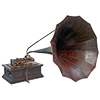
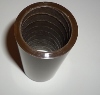
I did a little experiment to compare a good quality lateral disc with an Edison disc of the same period. Here you have "The US Field Artillery March on a Victor disc recorded in December 1917 and then on an Edison disc recorded in April 1918. Both discs are in E+ condition. The Edison is played using a Medved rebuilt Standard reproducer and the Victor played using a Marcus rebuilt Victrola no. 4 with a medium tone needle.
Both machines are in the same room, a few feet from each other. Same camera, same microphone, same distance from the machine when recording.
The difference is not nearly as pronounced on video as it is in person but I think you'll agree that the Edison is clearer, crisper than the lateral Victor up to you to judge.
I agree that the Edison is better once the initial barrage of surface noise clears up. Cymbals are clearer, the brass "bites" more. Of course, some of this will depend on the bandmaster's and engineer's preference. Edison always did seem to have the best acoustical disc recording process though, often even surpassing Columbia's late Harmony/ Diva/ Velvet Tone efforts in my opinion. I think Edison's acoustics are easier on the ears than the electrics a lot of times.
"He who dies with the most shellac wins"- some nutty record geek
Edison created the acoustically dead recording studio and specific recording techniques that resulted in better quality than its competitors at the start. I can hear the difference in the early instrumental records, pre WWI, but when I play the ones issued in the twenties I do not notice any consistent difference when comparing with Victor or Columbia records. Competition probably caught up by that time. Concerning vocals, to my ears, the Edison records sound consistently inferior to Victors and to Fonotipias-Odeons. The background noise of the Edison DDs during WWI period and up until the end of the second decade of last century is extremely high, making the listening of some of them displeasing.
Last edited by CarlosV on Sat Nov 02, 2019 7:44 pm, edited 1 time in total.
The Edison's sound better to my ears. I think Edison pushed the limit of the acoustical process. I think lateral acoustic may be able to be push this hard too, however they did not, for a good reasons they could not achieve the same high quality all the time, and the high frequencies would wear out on the Victor Discs, with frequent use of steel needles. (That may be the reason that experts say don't play post 1930's 78s on acoustical machines.) The Edison uses a diamond thus no need to limit the response for fear of wearing those frequencies out, (though a worn diamond will do the same). Lateral recording you have a volume limit, or fear of running into the next groove, Vertical, heat the master blank up more, and push the stylus down, yes though it can bleed to the next groove, but with the proper groove spacing it can be controlled. Mr. Miller also has the most experience in the recording business started recording when he was 17 in 1887. Edison also wanted "impossible" results, to hear each note, and each instrument, and the engineers made it happen, as Edison demanded it.
Edison was also deaf and liked the individual notes because he mostly listened to the records by feel or holding on to some part of the machine. He was an amazing man and could compensate for his problems. Tom
![[The Talking Machine Forum - For All Antique Phonographs & Recordings]](/styles/we_universal/theme/images/the_talking_machine_forum.png)