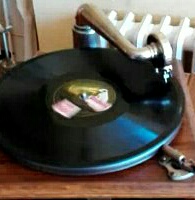
Hi All- I'm working on an Edison Standard Model "A"... The screws and "nuts" that attach the motor to the bedplate are the early, round, sleeve type. I've encountered these before and have been able to hold the edge of the sleeve with long-nose pliers to remove the screw- BUT- not this time. I have only been able to get one of the three loose.. The other two are kicking my backside.
*Any tricks that anyone can share??
Pics show one that was removed and one of the remaining two that is still attached.
Thanks in advance!
Brad Abell
Need TIP for Ed Standard Screw Removal
-
outune
- Victor IV
- Posts: 1421
- Joined: Mon Apr 26, 2010 3:13 pm
-
JerryVan
- Victor Monarch Special
- Posts: 6730
- Joined: Mon Aug 24, 2009 3:08 pm
- Location: Southeast MI
Re: Need TIP for Ed Standard Screw Removal
Brad,
I believe that those special nuts had rubber washers under them. The decomposed rubber is possibly what's got the nuts "glued" in place. With a small propane torch, gently heat the nuts. Don't get carried away. Just enough heat to make a slight bit of smoke should be plenty. While still hot, try to loosen it again.
-
outune
- Victor IV
- Posts: 1421
- Joined: Mon Apr 26, 2010 3:13 pm
Re: Need TIP for Ed Standard Screw Removal
Thanks Jerry--- I've gotta buy some butane to refill my little torch-- I'll try the heat- I was concerned that the brass sleeve may actually expand a bit with the heat and make it tighter-- But-- I'm not making progress any other way 
I'll give it a shot-- I think I have some of the rubber inserts somewhere-- Just need to get the darn screws out.
Thanks again!
Brad
I'll give it a shot-- I think I have some of the rubber inserts somewhere-- Just need to get the darn screws out.
Thanks again!
Brad
- Curt A
- Victor Monarch Special
- Posts: 6881
- Joined: Fri Jul 09, 2010 8:32 pm
- Personal Text: Needle Tins are Addictive
- Location: Belmont, North Carolina
Re: Need TIP for Ed Standard Screw Removal
Brad, Needle nosed vice grips have worked for me, otherwise it's hard to get a grip on them... Clamp the vise grips tight and then tap them with a mallet if necessary to get them started.
.
.
"The phonograph is not of any commercial value."
Thomas Alva Edison - Comment to his assistant, Samuel Insull.
"No one needs a Victrola XX, a Perfected Graphophone Type G, or whatever you call those noisy things."
My Wife
Thomas Alva Edison - Comment to his assistant, Samuel Insull.
"No one needs a Victrola XX, a Perfected Graphophone Type G, or whatever you call those noisy things."
My Wife
-
outune
- Victor IV
- Posts: 1421
- Joined: Mon Apr 26, 2010 3:13 pm
Re: Need TIP for Ed Standard Screw Removal
Hey Curt and Jerry- Just a follow up-- Those little buggers---were buggers to get loose. As mentioned, I've removed them on other machines without too much consternation-- but this machine had been (quite literally) put away wet-- Lots of rust and frozen parts. Everything required maximum effort to get apart-- I even had to cut the diaphragm clamp ring in the "C" reproducer, it was hopelessly seized up.
Anyway-- Happy to report that I got the motor-mount threaded sleeves loose-- I had to file a flat spot on opposite sides of two of them in order to get the long-nosed vise grips to... grip
Also used heat, after a long soak with PB Blaster. ....I found the correct 'cone' type motor rubber grommets in a parts box (bought from Ron Sitko many moons ago) So- This little Standard is once again playing music!
Success! Thanks for the help and suggestions.
Brad Abell
Anyway-- Happy to report that I got the motor-mount threaded sleeves loose-- I had to file a flat spot on opposite sides of two of them in order to get the long-nosed vise grips to... grip
Success! Thanks for the help and suggestions.
Brad Abell
-
JerryVan
- Victor Monarch Special
- Posts: 6730
- Joined: Mon Aug 24, 2009 3:08 pm
- Location: Southeast MI
Re: Need TIP for Ed Standard Screw Removal
Great news, Brad! Thanks for the follow-up. Reminds me of a horrible time I had with a Col. BD motor.
- Inigo
- Victor Monarch
- Posts: 4620
- Joined: Mon Dec 18, 2017 1:51 am
- Personal Text: Keep'em well oiled
- Location: Madrid, Spain
- Contact:
Re: Need TIP for Ed Standard Screw Removal
I would like to know how was it supposed to be disassembled and which tool must be used...??
Inigo
-
outune
- Victor IV
- Posts: 1421
- Joined: Mon Apr 26, 2010 3:13 pm
Re: Need TIP for Ed Standard Screw Removal
HI Inigo-- Here is my best guess-- These round headed sleeve nuts were intended to be "nested" into a rubber "boot" that goes through the hole in the motor casting. These boots were only used on the early Standards to my knowledge--and for a short time, later being replaced by the tapered spring and bolt set-up used on most other machines.
The set-up is meant to provide a vibration damper between the motor casting and the bedplate. I suspect that they were originally just tightened to a snug fit-- not overly tightened-- and were able to be removed either without pliers, or with just minimal gripping of the round head. **I'll attach a picture of the rubber boot that Brian Parlier sells on his phonograph shop website. Without these boots, there is no way to keep the motor from moving except to over tighten the screws and perhaps use a thin spacer.
Over the years as the rubber deteriorated or hardened/shrunk, the screws were likely tightened to compensate for the loose fit-- The machine I worked on had no remnants of the boot remaining, so the motor moved a lot when it was wound.
Hope this helps-
Brad Abell
The set-up is meant to provide a vibration damper between the motor casting and the bedplate. I suspect that they were originally just tightened to a snug fit-- not overly tightened-- and were able to be removed either without pliers, or with just minimal gripping of the round head. **I'll attach a picture of the rubber boot that Brian Parlier sells on his phonograph shop website. Without these boots, there is no way to keep the motor from moving except to over tighten the screws and perhaps use a thin spacer.
Over the years as the rubber deteriorated or hardened/shrunk, the screws were likely tightened to compensate for the loose fit-- The machine I worked on had no remnants of the boot remaining, so the motor moved a lot when it was wound.
Hope this helps-
Brad Abell
- Inigo
- Victor Monarch
- Posts: 4620
- Joined: Mon Dec 18, 2017 1:51 am
- Personal Text: Keep'em well oiled
- Location: Madrid, Spain
- Contact: