
It was in a restaurant in Philadelphia. Maybe sat like that for years in their basement and they decided to trash it. I found a wine card inside the case dated 1993. In these days with ebay I am surprised someone didn't remove the hardware.
![[The Talking Machine Forum - For All Antique Phonographs & Recordings]](/styles/we_universal/theme/images/the_talking_machine_forum.png)

Would you be able to share your technique for cleaning finishes? We're all curious! Thanks!jimmantwo wrote:Good idea - I'll try to get an email and send them pics. What if they claim it wasn't intended for trash and want it back?
It was in a restaurant in Philadelphia. Maybe sat like that for years in their basement and they decided to trash it. I found a wine card inside the case dated 1993. In these days with ebay I am surprised someone didn't remove the hardware.
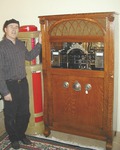

Victor's Fumed Oak finish was not dark. See this thread:startgroove wrote:FUMED OAK, near as I can tell from research online, is a process which mostly darkens the wood. Ammonia vapor is used to activate the tannins in the oak, causing it to turn dark. Long term exposure can make oak look nearly black, even the tiger striping will go dark given enough exposure. Long term exposure to air can also cause oak to darken, though that process is much slower. Further, it appears that lighter than normal oak is caused by another chemical process, like bleaching, which alters the natural color. BTW, since there are many kinds of oak, different species will react with different effects and color change in response to the chemicals.
One site I visited suggested a safer and easier way to get the fumed oak look. Stained with dark Watco oil and coated with a light clear finish seems to simulate fumed oak. Russie
Fumed oak can not be replicated with a stain or????. White Oak was used in almost all fumed oak. Even Victor sent notice to dealers stating "if" a fumed piece was damaged......it would need to returned back to the factory.startgroove wrote:FUMED OAK, near as I can tell from research online, is a process which mostly darkens the wood. Ammonia vapor is used to activate the tannins in the oak, causing it to turn dark. Long term exposure can make oak look nearly black, even the tiger striping will go dark given enough exposure. Long term exposure to air can also cause oak to darken, though that process is much slower. Further, it appears that lighter than normal oak is caused by another chemical process, like bleaching, which alters the natural color. BTW, since there are many kinds of oak, different species will react with different effects and color change in response to the chemicals.
One site I visited suggested a safer and easier way to get the fumed oak look. Stained with dark Watco oil and coated with a light clear finish seems to simulate fumed oak. Russie
It won't work with household ammonia - I found that out. Here's a demonstration of one man doing it. http://www.finewoodworking.com/how-to/v ... monia.aspx I think that furniture manufacturers like Stickley used an even stronger solution and heated it. Fumed pieces will also look darker today than they were originally because raw oak will darken on its own.gregbogantz wrote:I have my doubts that funed oak gets to be all that dark. A couple of years ago I tried an experiment to see how much darkening I could get from the process. I suspended a small piece of oak inside a closed glass jar with a pool of ammonia at the bottom. After a day or two, the oak had noticeably darkened, but it was only a medium brown color. So I left it alone to see what progress it made. None essentially. After a week or so, the terminal darkening had been achieved and after another two months or so, no additional darkening was observed. Which corresponds to what I see when I look at oak cabinets that are stated to be fumed oak. The color is medium to medium-dark brown. And it was typically finished with just a wax coat. I have an Edison C-250 that I thought was funed oak, but I have since found that it is evidently what is called "Flemish oak". It's almost black and has a semi-gloss finish, evidently from a final coat of shellac. It's an interesting and rare finish on this model. Anyway, if I were to want to achieve the look of funed oak today, I'd probably just use a stain and then wax the finish. Much less bother than trying to fume it.
Estott, Thanks for adding this. I was going to but I just didn't want to go on about the whole process. In the video, the man is using ammonia 24%. Somewhere here I have the percent strength that makers like Gus Stickley used. I believe it was over 75%.....estott wrote:It won't work with household ammonia - I found that out.
 . Very, very strong. I don't recall them heating the ammonia. Maybe because it was so strong there was no need ???. . I wonder how long he lived???.
I've actually used this technique to stain wood. It's possible to achieve a very dark brown stain if you have a high enough ammonium hydroxide concentration and leave the wood interacting with the ammonia for too long! Then again, I was working with an extremely high concentration of ammonium hydroxide.estott wrote:It won't work with household ammonia - I found that out. Here's a demonstration of one man doing it. http://www.finewoodworking.com/how-to/v ... monia.aspx I think that furniture manufacturers like Stickley used an even stronger solution and heated it. Fumed pieces will also look darker today than they were originally because raw oak will darken on its own.