Page 2 of 3
Re: Taper on Edison Cylinders
Posted: Tue Mar 22, 2016 3:00 pm
by Chuck
Yes, I've got some more numbers. A whole table of them,
in fact. But in the interest of brevity, I'll just say
here that the average of the six best and most reliable
examples comes to .030721, which when inverted becomes
32.5512.
Compare that to the target of .030769 which we are examining, and its inverted form of 32.5
Looking at the inverted form of these numbers paints
a clearer mental picture of it, I think.
What those inverted numbers mean is that for the first
example of 32.55, it means you'd need a mandrel
which is 32.55 inches long in order for the end
diameters to be exactly 1 inch different from each other.
In the case of the target of 32.5, this mandrel would
be .05 inch shorter than the above actual example.
Very very close for the average
taken from measurements of: (2) Edison standard model
"D" machines, Triumph model A, an Ediphone, a Dictaphone
shaver, and a Dictaphone blank.
Other obvious "outlyers" were omitted. Included in
the omitted ones are measurements from an oddball
early Edison Home from March, 1897.
Re: Taper on Edison Cylinders
Posted: Wed Mar 23, 2016 7:10 am
by edisonphonoworks
I used the taper on my two molds that Chuck used on his mold, except for my mold I multiplied the size by .02, because the wax I use to make blank cylinders shrinks 2% and that is why I do not need to ream the new blanks I make, except on a very rare occasion.
Re: Taper on Edison Cylinders
Posted: Wed Mar 23, 2016 8:22 am
by welshfield
I wonder whether you guys are not splitting hairs with all this precision. You are talking about differences of 0.15%. Variations in room temperature during measurement could account for much if not all of these differences, involving thermal expansion of both the mandrel material and your measuring gauges. It doesn't take much change in mandrel length due to thermal expansion to account for your differences. In fact, warming a mandrel in your hands while taking the measurement would cause it to expand considerably into your margin of measurement error. Consider also the inherent accuracy of manufacturing and machining tolerances during the early 1900s and it is possible that all your measurement differences can be accounted for.
John
Re: Taper on Edison Cylinders
Posted: Wed Mar 23, 2016 2:30 pm
by Chuck
Gentlemen,
These have all been very well thought out responses
to Mr. Cawley's original post. Yes, there are many factors at work here, including thermal expansion due to temperature, manufacturing tolerances, and measuring errors.
For myself, this most recent uncorking of this particular
very long-standing can of works has yielded up some
good new data. Mr. Cawley's suggested taper which is
shown on the diagram on the linked page he provided
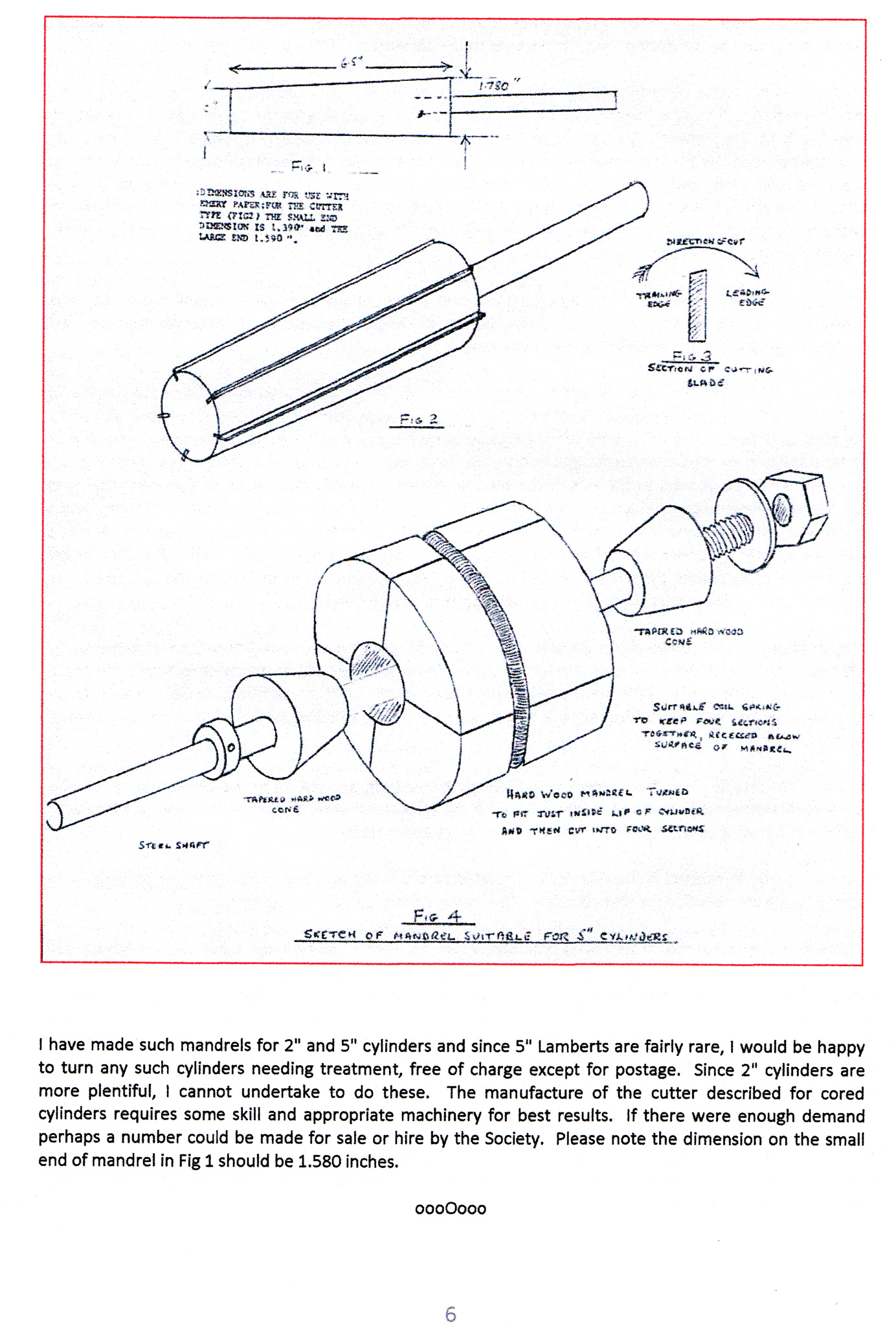
very clearly shows a diameter difference of .2 inches
spread out over a length of 6.5 inches. That works
out to a taper of exactly 1 in 32.5
From a table which I made of 11 examples of various
mandrels measured, 6 of those cluster very close
to Mr. Cawley's suggested taper of 1 in 32.5
So, for me, this is pretty well settled for now.
My notes which go clear back to 1978 have been
annotated with this most recent info.
It would still be interesting for all of us on this
forum to find out a little more of the background
about the origin of the sketch shown on the link which
Mr. Cawley provided.
A few questions I have about it:
Who's sketch is it?
How did they come up with those numbers?
i.e. They are certainly rather accurate numbers, but
where did they come from? Did the person who made the
sketch arrive at these numbers by measuring mandrels
as we have been doing endlessly in this thread? Or
did those numbers come from an original manufacturing
detail drawing?
Not to be beating a dead horse or anything.
However, this particular horse has gotten up and
started running around several other times before,
after being thought dead.
Re: Taper on Edison Cylinders
Posted: Thu Mar 24, 2016 3:09 am
by Dave Cawley
.
So, is 1:32 correct on 110 year old mandrels? A taper of 0.2" on 6.5" is unlikely, as 0.2" would not be a unit used at the time, fractions were. Could it be that 1:32 was the original goal and tolerances/wear have slipped in ?
Some have asked for more information relating to the drawing, I hope this helps. The other text does not say how the measurements were obtained at all. As usual if you click on the drawing it should get bigger ?
The taper drawing
http://www.soundhifi.com/FOURUMIMAGES/taper.jpg
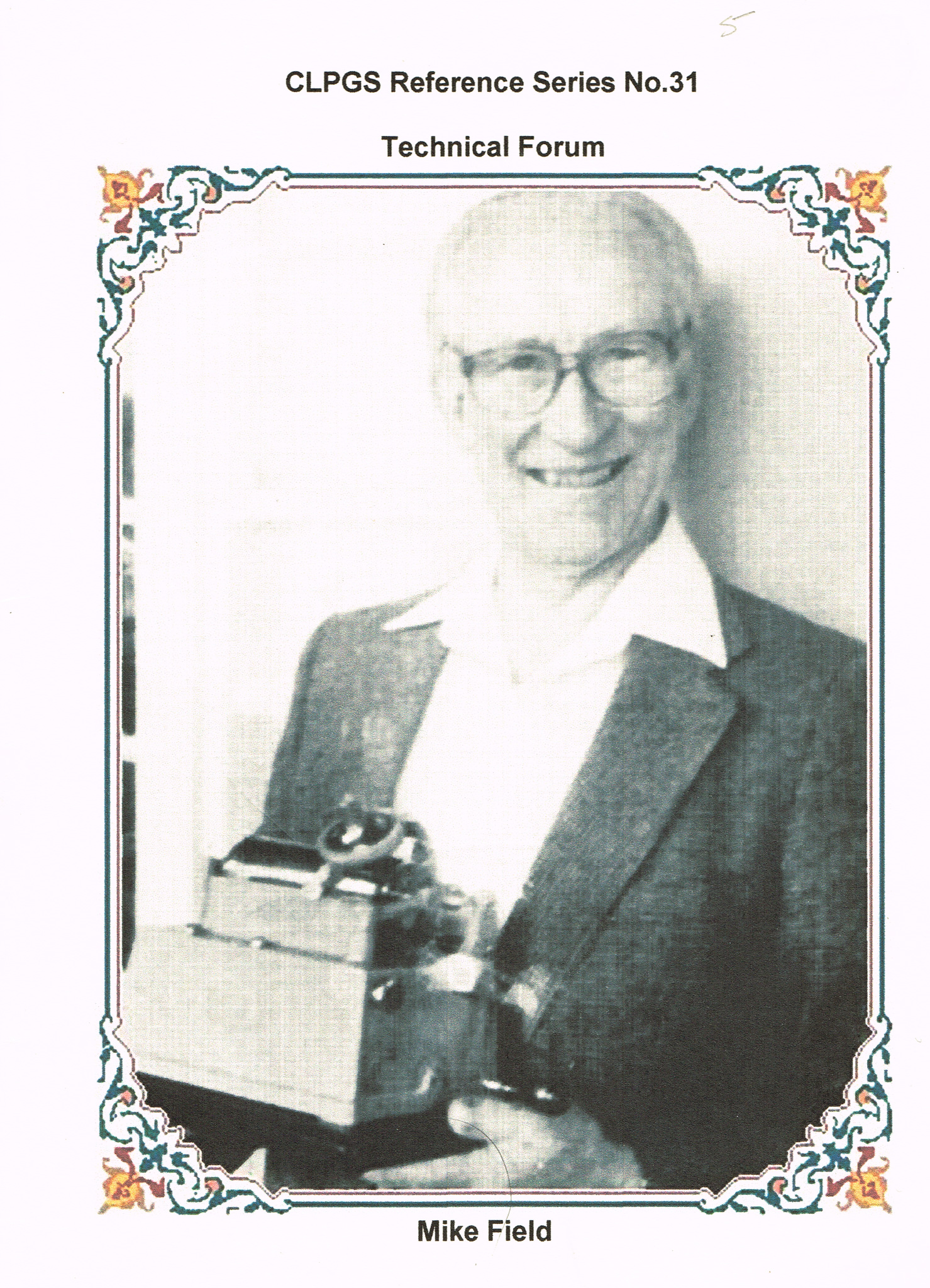
CLPGS Reference Series No.31 Technical Forum front cover
http://www.soundhifi.com/FOURUMIMAGES/no31.jpg
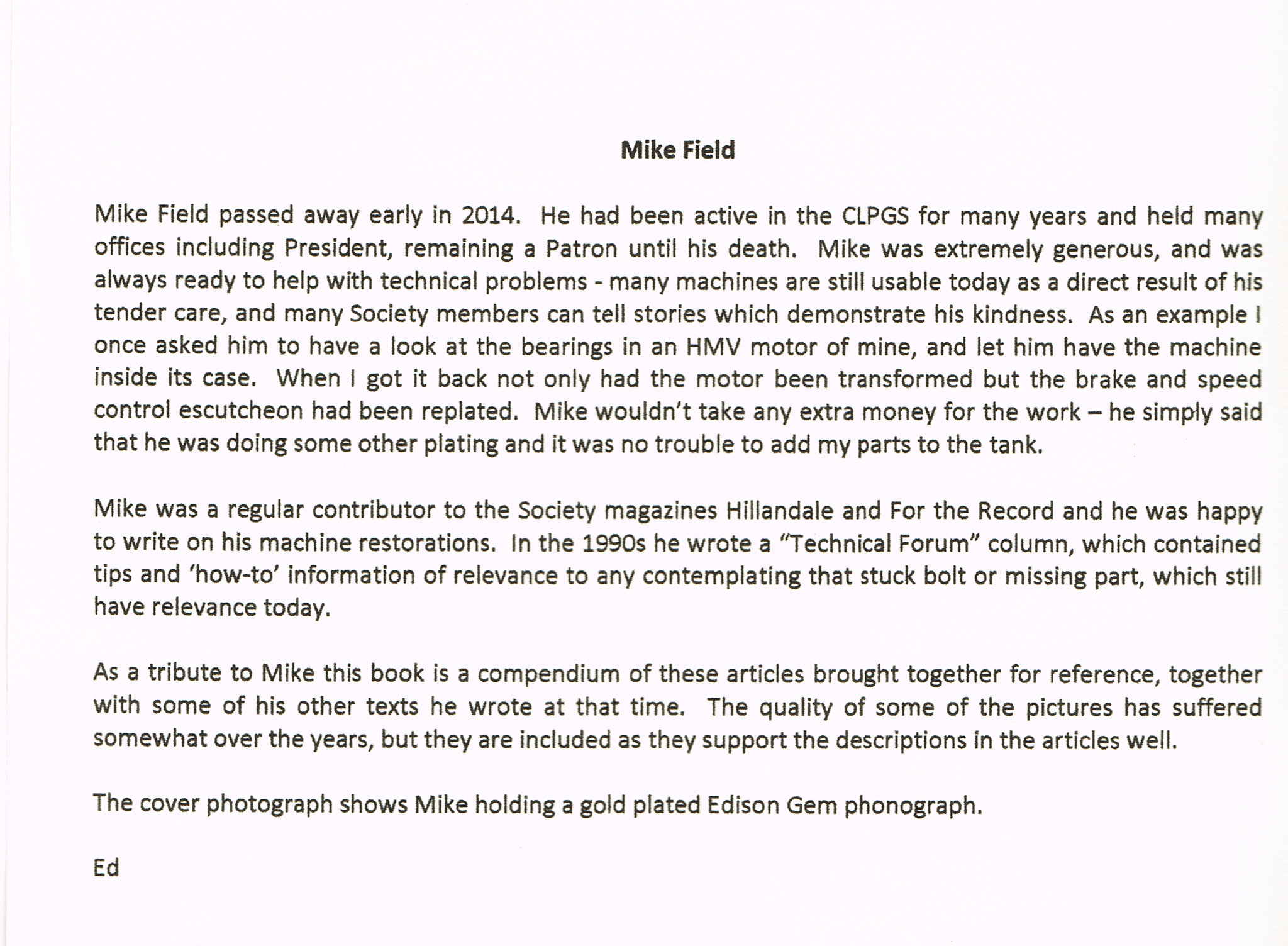
Forward about Mike Field
http://www.soundhifi.com/FOURUMIMAGES/mikeield.jpg
Were to buy the book
http://www.clpgs.org.uk/reference-series.html
But the
big question is, how difficult would it be to access the original drawing from the Edison Archive ?
Thanks
Dave
Re: Taper on Edison Cylinders
Posted: Thu Mar 24, 2016 1:21 pm
by Chuck
Dave, thank you for the response, and for offering a bit
more background about the origin of the reamer drawing
which shows the .2 in 6.5 inch taper.
It is my considered opinion at this point, based upon
this bit of info which you have so generously offered, that the taper of 1 in 32.5 is a much better description of what we measure today on these mandrels.
The taper of 1 in 32 just tends to fall outside of
the typical range of a large number of measurements.
The taper of 1 in 32.5 tends more to fall a whole lot
closer to the center of the range.
Also, when looked at as a ratio such as 1 in 32.5, the
numbers used are quite simple and direct. No long
random-looking decimal numbers.
So, at this point, I would have to say, nope, 1 in 32
was likely not the original specification. It really
is more like 1 in 32.5, or perhaps some other very close
fractional number such as 1 in 32.5625 or 1 in 32.4375
But so far it appears from many measurements that
1 in 32.5 falls so close to the center of the overall
range that the results suggest it strongly.
As for ever getting to see the original detail drawings,
one would need to arrange a special appointment at
West Orange, NJ, and then go into the drawing vault and
begin searching for them. That is the only way I know
of. And that assumes that those original drawings
are actually still there and have not "gone missing".
Wink, wink, nudge, nudge.
Re: Taper on Edison Cylinders
Posted: Thu Mar 24, 2016 4:25 pm
by welshfield
This is extremely interesting. It's a wonder that no one has pursued this before.
Question: How about Columbia and other producers of cylinders and machine mandrels? Are you assuming that they will follow Edison's example? More specifically, will there be any noticeable difference when using, say, one of your blanks between a mandrel made to 1:32 or 1:32.5 (or vice versa)? Or even 1:31.5 ? Or an Edison cylinder on a Columbia mandrel ?
John
Re: Taper on Edison Cylinders
Posted: Thu Mar 24, 2016 5:45 pm
by Chuck
Welshfield,
As far as I know, all cylinder phonograph brands have
the same taper. I myself do not own any Columbia machines. My data comes from Edison mandrels, and from
Dictaphone shavers.
It is a simple enough calculation to find out what
slight variations on this taper will do to the fit
of a 4.25 inch long cylinder record on a mandrel.
In general, using the observed range of measurements,
when taken to extremes, it can be seen that in some
of the worst-case fits, the result is a slight looseness
or wobble on one end of the record. This is usually
only a few thousandths of an inch at most, and most times the record will go snug with a little shove.
Again, there is an acceptable range to these mandrels
and of course the old records themselves can sometimes
be way, way off due to shrinkage and distortion from
round.
My general setup when finishing my brown wax blanks is
to do the reaming directly on the shaver's mandrel
using sandpaper wrapped around it.
But yes, you are correct in that it's a real mystery
as to why this data about this taper has not been
widely sought after and documented. I guess those who
really need this data are so few that it mostly gets
kept quiet.
Those who have made new mandrels for such machines as
the Archeophone, or any of the other various high-end
modern cylinder players used for archiving, must all
have, at some point, arrived at their mandrel dimensions
from some source.
For whatever reason, this topic does not appear to be
one which has been discussed much, nor defined, nor have
the original manufacturing detail drawings been
publicized.
So far, the exact taper has been left to whomever
wants to work it out for themselves.
Like I have said, it's a very large can of worms.
In my own private opinion, I tend to trust mandrel
measurements taken from the genuine Edison products
as being the most accurate.
Re: Taper on Edison Cylinders
Posted: Fri Mar 25, 2016 11:04 pm
by RefSeries
To add to the debate I have looked through Edison's phonograph patents and can find no numerical definition of mandrel taper. The only statements I can find seem to say that it is ⅛" per foot. In fact Frank Andrews quotes the following in an article he wrote for the CLPGS Hillandale magazine in the 1990s -
------------------
...Correspondence and argument broke out spasmodically during the ensuing years, generating a lot of heat, but not much light. J.L Young's claim that he joined the Edison Phonograph business in London in 1887, seems to be based on the fact that he joined Colonel G Gouraud in that year, but as he says Edison had not produced his new style phonograph until December 1887, it was hardly likely that there was any Edison Phonograph business in London before January 1888.
Young says he was officially informed that the apparatus was completed in November 1887 and in the April 1907 issue of "The Phono Trader and Recorder" he published a letter received in London from Edison, dated Nov. 16th 1887, which read;
"New phonograph is a darling; the talking is perfect. I get the whispering fair, but shall get whispering perfect; today had boy (Hamilton) read off one page of "History of Maryland". "Bachelor" was sent for, and got every word. The "Scientific American" artist and reporter was over yesterday. I read 500 words from the "World", the artist never saw a phonograph before. He got 85 per cent, the first time and all but one word the second time.
"Have solved the mailing — viz., the drum of the phonograph is one piece, 4 inches long, with a taper of ⅛ inch. "You can slip a full-sized cylinder over this or a half-size, 2 inches long, or a quarter-size 1 inch long. You slide it along until it fits the taper of the phonograph drum. Hence we shall furnish four sizes of phonograms — all the same diameter, but different lengths, 1, 2, 3 and 4 inches. "You remember the old style wooden (round) match-box made from pine? I use these for making boxes. Automatic machines have been used for years to make these. They cost a mere nothing; are very stiff, and very light.
---------------
It is repeated elsewhere:
-------------------
FROM “WORKSHOP RECEIPTS”. VOL. III, 1926, Published by E. & F. N. Spon, Ltd.
PHONOGRAPH RECORD CYLINDERS
The master, and also the actual working records are shaped as shown in Fig. 1. They are -- for the majority of the Edison phonographs, about 4 in. long and 1. 3/16-inch diameter. The bore is a taper ⅛ in. to the foot, to suit the phonograph mandrel, and a number of recesses are formed, as shown, leaving bearing rings or surfaces 3/16 in. wide. The master blanks are moulded from a white wax preparation. The inside is finished, and the outside then turned a few thousandths of an inch taper, the finished cylinders being as smooth as glass, and having the appearance of polished ivory. They are turned, or shaved, in small phonographs mounted on a workbench, and belted from shafts at the back of the bench.
--------------------
However this is at odds with the measurements made of phonographs of the day. Mike Field's reamer design mentioned by others (also from the CLPGS magazine) suggests a taper of 0.1846"/foot (ie half of 0.2" in 6.5" long mandrel). I have just measured some Edison mandrels at home and come up with an average close to 0.19" per foot, which matches Mike's numbers and those of Chuck Richards. However as Chuck says, Edison will surely not have used many decimal places, and certainly not used metric measurement, so perhaps 1 in 32.5 is a fair proposal. However why this taper anyway? Was it the result of experiment?
All very interesting!
Keith
Re: Taper on Edison Cylinders
Posted: Sat Mar 26, 2016 7:46 am
by Dave Cawley
RefSeries wrote:. "Have solved the mailing — viz., the drum of the phonograph is one piece, 4 inches long, with a taper of ⅛ inch. "
Well, this is exactly 1:32 then !