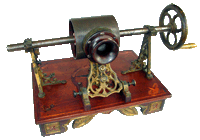
MTPhono wrote: I been Don Wilson could do this - what do you think Don? Are you up for a challenge? It would be greatly appreciated by many.
Do you still have the broken pieces? I could probably put at least one of them back together.
And yes, I could make them in hard-wearing resin or chocolate (I also have food grade molds). But I'll need one to copy, or maybe I could make a vertically cut disc if I knew the stylus diameter.
Unfortunately the records were so far gone I didn't keep any pieces. I do have one original (larger 4 ¾") but not the earlier 3" version. I believe most would be interested in the earlier 3" version of the record.
I had a customer years ago who had a Eureka without discs. He asked me to make some for his machine. I started the project but soon abandoned it due to lack of time. That is the problem. It takes so much time to accomplish the final result and the pay off is not worth the effort. I think I still have the polished brass blank I was going to make a mold of to make wax blanks for recording. If I can find it I will give it to Don Wilson and he can do something with it.
Here's update #1. The first copies of the pre-repair original have been made and will be at the Wayne show this weekend. An artist has been commissioned to recreate the original box and graduates from the CIA (Culinary Institute of America) will be helping me formulate the chocolate recipe.
Donnie's work on this is truly amazing! That copy looks eerily like the original (not that I should be surprised after all those wonderful Berliner copies).
There is one very curious aspect to this recording, which I mentioned to Donnie last night: it is obviously the same, very familiar song, but the lyrics are completely unlike the usual "Allons les enfants de la Patrie, le jour de gloire est arrivé." Like any early record the sound is just fuzzy enough that it took me a couple of times to understand it fully, and I was very confused. I did some Googling and eventually found a link to a French government page with the full lyrics of the song. I had not previously known that there were many stanzas in the original, but only the first two are sung today. This record features a truncated version of the now (apparently) forgotten third stanza, with a slightly truncated version of the familiar ending (second) stanza. So I learned something completely new.
This is what is on the record: "Que veut cette horde d'esclaves, De traîtres, de rois conjurés? Pour qui ces ignobles entraves, Ces fers dès longtemps préparés?" then skipping back to the usual second stanza (shortened) that is familiar today. They cut out the second half of the third stanza. Obviously they had very limited time (only 30 seconds) so a lot of liberties were taken.
But I am still amazed that Stollwerck / Eureka opted to record that stanza rather than the usual (even then) opening stanza. I have a Lioret celluloid cylinder of the 1890s of the Marseillaise, it has the completely familiar typical lyrics. It seems unfathomable that they wouldn't have gone with the normal opening stanza. Even if in 1903 the later stanzas hadn't been abandoned, jumping essentially into the middle of the song seems an odd choice.
That's a detail which only people who understand French will ever notice, but it was a serious mind-blower for me. I learn something new every day, which is something I love about this hobby.
![[The Talking Machine Forum - For All Antique Phonographs & Recordings]](/styles/we_universal/theme/images/the_talking_machine_forum.png)